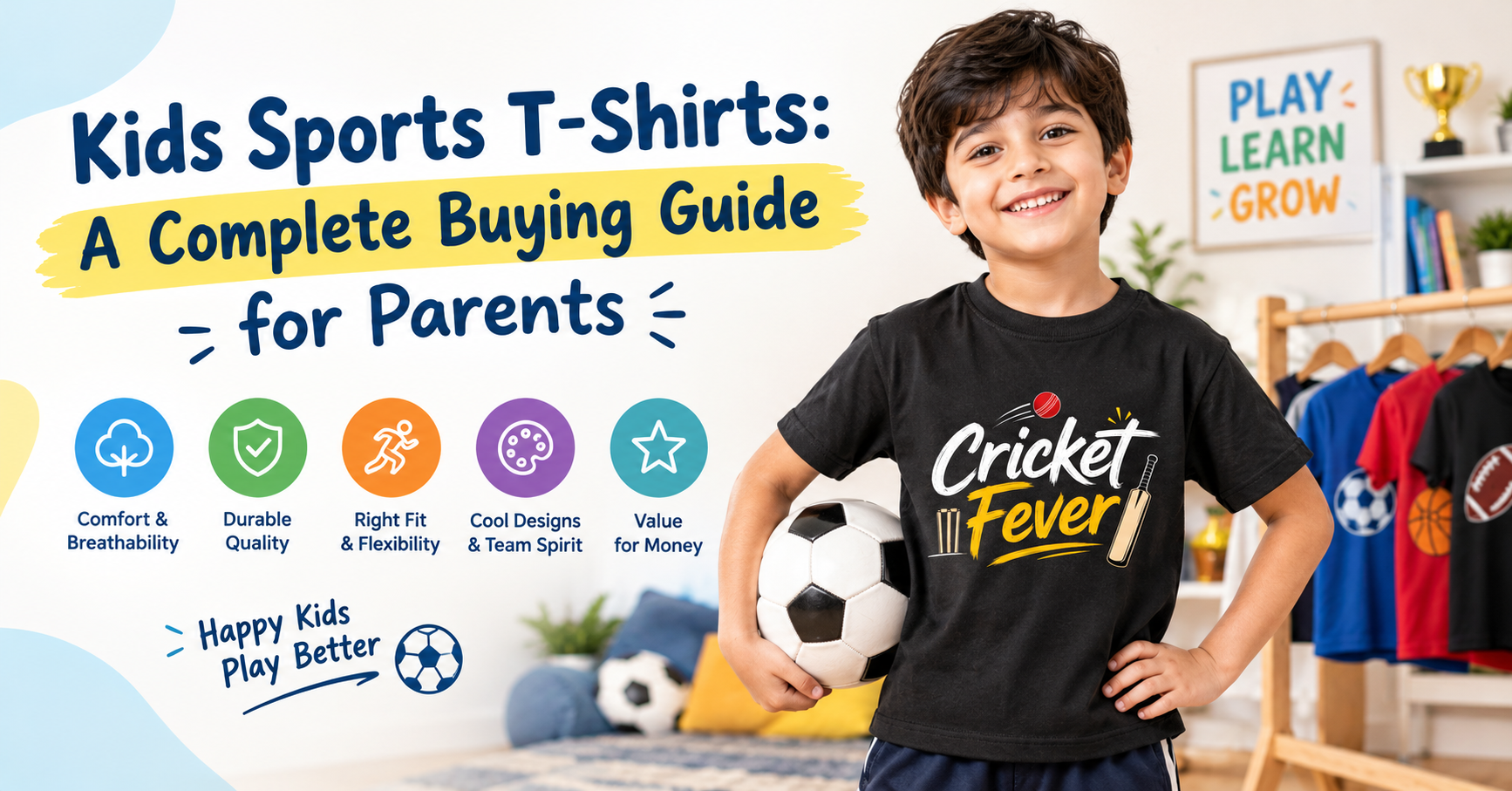
Choosing the right sportswear for children involves more than picking an attractive design. Kids need clothing that allows them to run, jump, stretch, and play comfortably without constant adjustments. Whether your child participates in school sports, plays outdoor games, attends sports classes, or simply enjoys an active lifestyle, the right T-shirt can make everyday activities more comfortable.
When shopping for kids sports t shirts, parents should consider fabric, fit, breathability, durability, ease of washing, and overall value for money. A T-shirt that looks good but feels uncomfortable during physical activity may not be a practical choice for regular use.
KayoBaby understands the importance of comfortable, practical clothing for growing children. This guide explains what parents should look for when buying sports T-shirts for kids, how to choose the right fit, which materials are suitable for different activities, and how to make a purchase that meets both comfort and budget requirements.
Why Choosing the Right Kids Sports T-Shirts Matters
Children are constantly moving, especially during outdoor play, school activities, and sports practice. Their clothing needs to accommodate these movements without feeling restrictive or uncomfortable.
A suitable sports T-shirt can help children feel more comfortable during physical activities. However, the best option depends on the activity, weather, fabric, and individual preferences.
Here are some important reasons to choose sportswear carefully.
Comfort During Physical Activity
Running, jumping, cycling, and playing football require freedom of movement. A T-shirt that feels too tight around the shoulders or arms can become uncomfortable during these activities.
Look for a comfortable fit that allows your child to move naturally. The sleeves should not restrict arm movement, and the body should provide enough room without excessive fabric getting in the way.
Breathability for Everyday Play
Children can become warm during active play, particularly in summer. Lightweight fabrics that allow air to circulate can make sportswear more comfortable.
Parents should check the fabric composition and thickness before buying. A breathable cotton-blend T-shirt may work well for casual activities, while moisture-wicking synthetic fabrics may be more suitable for intense exercise.
Durability for Frequent Washing
Sportswear often needs washing after outdoor games, physical education classes, and sports practice. Repeated washing can affect fabric softness, colour, and shape if the garment is poorly made or incorrectly cared for.
Check the stitching, neckline construction, and fabric quality. A well-constructed T-shirt can offer better long-term value than a cheaper option that quickly loses its shape.
How to Choose the Best Fabric for Kids Sports T-Shirts
Fabric is one of the most important factors when shopping for children's sportswear. Different materials offer different benefits, so parents should select one according to how the T-shirt will be used.
1. Cotton for Everyday Comfort
Cotton T-shirts are popular because they feel soft and are generally comfortable for daily wear. They can be suitable for light activities, casual outdoor play, school outings, and everyday use.
However, cotton absorbs moisture and can remain damp during intense exercise. If your child sweats heavily during sports practice, a cotton T-shirt may feel heavier and less comfortable.
Best for: Casual play, light activities, and everyday wear.
2. Polyester for Active Sports
Polyester is commonly used in performance sportswear because it is lightweight, dries relatively quickly, and can help move moisture away from the skin when the fabric is specifically designed for that purpose.
Not every polyester T-shirt has the same performance characteristics. Fabric construction, ventilation, and finish also influence comfort.
Best for: Running, football practice, cycling, and other activities that involve sustained movement.
3. Cotton-Polyester Blends for Versatility
Blended fabrics combine properties of different fibres. Depending on the blend, a cotton-polyester T-shirt may offer a balance of softness, shape retention, and easier maintenance.
Check the actual fibre composition rather than assuming every blend performs identically.
Best for: Everyday activities, school sports days, and children who need versatile clothing for multiple occasions.
What Should Parents Choose?
For relaxed outdoor play, a soft and lightweight cotton T-shirt may be sufficient. For intense physical activity, consider sports-specific fabric designed for moisture management and quick drying.
If your child participates in several activities, having one everyday T-shirt and one dedicated performance T-shirt can be a practical approach.
How to Find the Right Size and Fit
Choosing the correct size is particularly important when buying kids sports T-shirts online. Children grow quickly, but buying a garment that is much too large can interfere with comfort and movement.
Check Chest Measurements
Use a measuring tape to measure around the fullest part of your child's chest. Keep the tape comfortably positioned rather than pulling it tightly.
Compare the measurement with the brand's size chart. Do not rely exclusively on your child's age because children of the same age can have different body proportions.
Consider Shoulder and Sleeve Fit
The shoulder seams should sit comfortably near the natural shoulder line for a regular-fit T-shirt. Sleeves should allow free arm movement without feeling excessively tight.
For activities involving throwing, stretching, or racket sports, check that the fabric does not pull uncomfortably across the shoulders.
Check the Length
A T-shirt should cover the waist during normal movement. If it becomes too short when your child raises their arms, consider a longer style or another size.
At the same time, an excessively long T-shirt may feel inconvenient during running or organised sports.
Should You Buy a Bigger Size?
Buying one size larger can sometimes extend the useful life of a garment, especially if your child is between sizes. However, the fit should remain practical for current use.
Before sizing up, check the garment's measurements. Some brands already offer a relaxed fit, so choosing a larger size may make the T-shirt unnecessarily loose.
Important Features to Check Before Buying
Not every T-shirt marketed as sportswear is designed for demanding physical activity. Review these features before making a purchase.
Lightweight Construction
Lightweight fabric can help clothing feel less cumbersome during running and games. However, lightweight should not mean poorly constructed. Check whether the fabric feels appropriate for the intended activity.
Comfortable Neckline
A neckline that is too tight can make a child uncomfortable, particularly when putting on or removing the T-shirt.
Crew-neck designs are common, but the opening should stretch comfortably and return to its original shape without excessive pulling.
Smooth Seams and Good Stitching
Rough seams or poorly finished edges can cause irritation during movement. Examine product photographs and descriptions for details about stitching and construction.
For frequent sports use, reinforced seams may be worth considering, especially around the shoulders and sleeves.
Easy-Care Fabric
Parents often need to wash children's clothes frequently. T-shirts that are easy to maintain can save time and effort.
Before purchasing, review the washing instructions. Check whether the garment requires special handling, low-temperature washing, or air drying.
Suitable Design and Colour
Children are more likely to enjoy wearing clothes that reflect their personal preferences. Sports-inspired graphics, bold colours, and simple athletic designs can make a T-shirt appealing.
For activities where clothes may become muddy, dusty, or stained, consider colours and prints that are practical to maintain.
Choosing Kids Sports T-Shirts for Different Activities
The right T-shirt depends on where and how your child will wear it. A single style may not be ideal for every situation.
For School Sports Days
School sports days often involve running races, group games, and outdoor activities. Choose a comfortable T-shirt that allows unrestricted movement and feels appropriate for the weather.
If the school specifies a uniform colour or design, check those requirements before ordering.
For Football, Cricket, and Team Practice
Team sports often involve sustained movement and sweating. Lightweight sportswear designed for moisture management can be a useful choice.
Look for a fit that allows running, bending, and raising the arms comfortably. If the child wears protective equipment, check that the T-shirt fits comfortably underneath it where appropriate.
For Running and Cycling
Running and cycling require clothing that stays comfortable during repeated movement. A lightweight, well-fitting T-shirt can reduce unnecessary bulk.
For outdoor cycling, visibility is also worth considering. Brighter colours may help children stand out in certain environments, although a bright T-shirt is not a substitute for appropriate safety equipment.
For Casual Outdoor Play
Children do not always need specialised athletic clothing for casual games in the garden, park, or playground.
A soft, comfortable T-shirt with sufficient room for movement may be perfectly adequate. Parents can prioritise everyday versatility if the garment will also be worn at home or during outings.
Kids Sports T-Shirts vs Regular T-Shirts
Although sports T-shirts and regular T-shirts can look similar, their intended uses may differ.
Sports-specific T-shirts may use moisture-management fabrics, lightweight construction, and designs intended for repeated movement. Regular T-shirts often focus more on everyday comfort, appearance, and casual wear.
Neither option is automatically better for every child.
For example, a child attending a short school activity may be comfortable in a regular cotton T-shirt. A child who regularly attends football practice may benefit from a performance T-shirt designed to dry quickly.
Before buying, consider the activity's duration, intensity, weather conditions, and your child's comfort preferences.
How Much Should Parents Spend on Kids Sports T-Shirts?
The price of a kids sports T-shirt can vary depending on its fabric, construction, design, brand, and intended use. Rather than choosing solely by the lowest price, compare the features that matter for your child's activities.
Consider Cost Per Wear
A useful way to assess value is to estimate how often the T-shirt will be worn.
For example, imagine two T-shirts: one costs less but becomes uncomfortable or loses its shape after a few washes, while another costs slightly more and remains suitable for regular use. The second option may provide better value if it lasts considerably longer.
This is not guaranteed by price alone, so fabric quality and construction should guide your decision.
Avoid Paying for Unnecessary Features
Children may not need premium performance features for every activity. If your child mainly wears sports T-shirts for casual play, a comfortable, durable everyday option may be sufficient.
If your child trains regularly, investing in suitable sportswear may be worthwhile.
Check Shipping and Return Policies
When buying kids sports T-shirts online, consider the total cost, including shipping charges and any applicable return or exchange fees.
Review the size chart and return policy before ordering. These details are especially important when purchasing clothing as a gift or buying several sizes for a growing child.
Common Mistakes to Avoid When Buying Kids Sports T-Shirts
Parents can make more confident purchasing decisions by avoiding a few common mistakes.
- Choosing by appearance alone: An attractive design does not guarantee comfortable fabric or a suitable fit.
- Ignoring the size chart: Age-based sizing varies between brands, so measurements are more reliable.
- Buying thick fabric for hot weather: Heavier material may feel less comfortable during outdoor activity in warm conditions.
- Assuming every synthetic fabric is moisture-wicking: Check whether the product specifically describes moisture-management features.
- Buying too many T-shirts at once: Try one garment first if you are unfamiliar with a brand's sizing or fabric quality.
- Ignoring washing instructions: Incorrect washing and drying can affect colour, shape, and fabric performance.
- Overlooking the intended activity: Everyday clothing and performance sportswear serve different purposes.
Why Consider KayoBaby for Children's Clothing?
When shopping for children's T-shirts, parents should prioritise comfort, fit, appealing designs, and practical everyday use.
KayoBaby offers children's clothing options for families looking for wearable styles for growing kids. When exploring its range, check the available designs, fabric details, size information, and care instructions to determine whether a particular product suits your child's needs.
If you are shopping for everyday T-shirts as well as sportswear, consider how each garment will be used. A comfortable casual T-shirt may be suitable for relaxed activities, while demanding sports sessions may call for a dedicated performance garment.
You can explore the relevant children's T-shirt collection on the KayoBaby website and compare the available options before choosing a style.
Frequently Asked Questions About Kids Sports T-Shirts
1. Which fabric is best for kids sports T-shirts?
The best fabric depends on the activity. Cotton can be comfortable for everyday wear and light play, while sports-specific polyester fabrics may be better suited to intense exercise because some are designed to manage moisture and dry quickly.
2. Are cotton T-shirts suitable for sports?
Yes, cotton T-shirts can work well for light exercise, casual games, and short outdoor activities. However, cotton absorbs sweat and may stay damp during prolonged or intense exercise.
3. How do I choose the right size for kids sports T-shirts online?
Measure your child's chest and compare the measurement with the seller's size chart. Also check the T-shirt's length, shoulder fit, and sleeve measurements where available. Avoid relying on age alone.
4. How many sports T-shirts does a child need?
The number depends on the child's routine. A child who participates in sports several times a week may benefit from having three to five suitable T-shirts in rotation, while occasional activities may require fewer.
5. Can kids wear sports T-shirts every day?
Yes, provided the T-shirt is comfortable, appropriate for the weather, and suitable for the activity. Everyday T-shirts can work for casual play, while specialised sportswear may be more useful for regular training.
6. What should I check before buying kids sports T-shirts online?
Check the fabric composition, size chart, fit, stitching, washing instructions, product photographs, total price, delivery charges, and return or exchange policy.
7. How can I make kids sports T-shirts last longer?
Follow the care label, wash similar colours together, use a suitable detergent, and avoid excessive heat when drying. Treat stains promptly and avoid harsh washing methods that may damage the fabric or print.
8. Are expensive kids sports T-shirts always better?
No. A higher price does not automatically mean better comfort or durability. Compare the fabric, stitching, fit, care requirements, and intended use to determine whether the product offers good value.
Conclusion
Buying the right kids sports T-shirts becomes easier when you focus on how your child will actually use them. Fabric, fit, breathability, construction, and maintenance all influence whether a T-shirt is comfortable and practical for regular wear.
For casual play, a lightweight and comfortable everyday T-shirt may be enough. For frequent training or intense sports, consider sports-specific fabrics designed to manage sweat and support movement. Always check the size chart and product details before ordering online, particularly when shopping for a growing child.
KayoBaby can be part of your search for children's clothing that combines appealing designs with everyday practicality. Explore the available kids' T-shirt options, compare their features, and choose styles that suit your child's activities, comfort preferences, and budget.
The best choice is a T-shirt your child feels comfortable wearing and that meets the demands of their everyday routine.